Milliarum at the SAP Innovation Days PLM 2025
May 8, 2025:
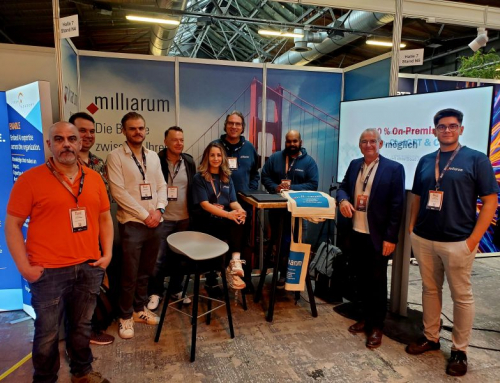
We look back on exciting keynotes, thought-provoking insights, and inspiring discussions at the SAP Innovation Days PLM 2025 on May 6 and 7, 2025, in Heidelberg.
This has clearly demonstrated that the SAP ECTR solution is essential in the SAP PLM environment. However, the integration of SAP ECTR with SAP EPPM is still largely unknown. This is where Milliarum comes in: Together with our partner, DSC Software AG, we have developed the ++projectSystem, which bridges the two worlds.
The ++projectSystem connects the SAP environment with that of a design engineer: The tool consolidates all data and documents via the worklist into a single ECTR work item. There, documents from design solutions such as CATIA and AutoCAD, or other tools such as Word and Excel, can be linked, and all steps in the plan can be documented. Project progress, generated documents, and work sequences are transparent to all users at all times. Redundant data storage is eliminated, approval processes are streamlined, and project progress is traceable at all times.
Would you like to learn more about the ++projectSystem?
Sprechen Sie uns an! Tel: +49 21 66 / 3 10 11 06, Mail: info@milliarum.de

April 2, 2025: Product Development in SAP: From Silo Thinking to an End-to-End Process Chain
Project management’s strong cross-departmental connections throughout the entire company make product development efficient. At the same time, project management operates in a constant state of tension: It must balance flexibility and structure, resolve resource conflicts, and adapt to a dynamic market environment. A patchwork of siloed solutions creates hurdles for project managers when it comes to consolidating all the necessary data. How companies will overcome these challenges in the future to successfully bring products to market will be discussed at the May 6 and 7, 2025 Discussed at the SAP Innovation Days PLM. Milliarum is there!
Product development doesn’t always run smoothly: Constant change requests and innovative product ideas often clash with limited resources within companies. In SAP-dominated environments, developers navigate a complex system landscape. Many companies rely on siloed solutions that map the specific requirements of individual departments like a patchwork quilt and operate in isolation. Utilizing the generated data across the entire process chain often requires complex interfaces for development and maintenance. Yet well-maintained and structured data is at the heart of future-proof product development. It enables end-to-end process digitization and paves the way for new technologies and artificial intelligence. Many companies shy away from data harmonization, as it is a complex undertaking that puts business processes through a thorough test. Yet it lays the foundation for AI-driven automation, and only an overview of resources and projects provides a solid basis for decision-making in efficient project planning. Various approaches can support this complex undertaking.
++projectSystem: Integrating SAP Data with Design Solutions
To better integrate product data, technical systems, and the ERP, SAP offers ECTR—a unified workspace where design and development data can be managed directly in SAP and linked to other business processes. Business data—from which key performance indicators for development quality, such as lead times, the number of successful projects, the number of change requests per project phase, costs, and resource consumption, can be derived—is mapped in the SAP Project System (SAP-PS). To integrate the data from SAP-PS with that from ECTR, Milliarum, in collaboration with DSC Software AG, developed the ++projectSystem. An SAP EPPM version based on SAP PPM is also available as part of a First Customer Shipment. The tool connects the SAP environment with that of a design engineer and consolidates all data and documents into an ECTR work item via the worklist. There, documents from design solutions such as CATIA and AutoCAD—or other tools such as Word and Excel—can be linked, and all steps in the plan can be documented. Project progress, generated documents, and work sequences are traceable at any time for all users. Redundant data storage is eliminated, approval processes are shortened, and project progress is traceable at all times.

Meet Milliarum CEO Steffen Wester-Ebbinghaus in person at the SAP Innovation Days PLM and schedule an appointment with him now at our partner DSC Software AG’s booth!
Cell: +49(0) 0172 2063248
Email: steffen.wester-ebbinghaus@milliarum.de
CTO+: Standardize and Automate Sales Order Processing with Configuration
By integrating PLM and EPPM, the Configure-to-Order (CTO+) approach can be extended from product configuration to process configuration. The result is more efficient sales order processing within flexible development and production networks. Configure-to-Order (CTO+) approach. It is based on the premise that manufacturers should offer customer-specific, configurable products using largely standardized processes. The solution portfolio includes, for example, project configuration, project bills of materials, and project scheduling. This makes it possible to automatically derive an MBOM from an EBOM based on characteristics and source locations, taking into account plant- and process-specific requirements. The solution is complemented by capacity and resource management, which clearly displays project requirements and available resources within the organizational structure. This allows bottlenecks at the resource, time, and knowledge levels to be identified early on so that appropriate measures can be taken. Milliarum also integrates the Theory of Constraints (TOC) and Critical Chain Project Management (CCPM) into SAP environments. Functional enhancements integrate Lean/Critical Chain project management, real-time capacity data, an early-warning system for schedule deviations, simulation functions, and informative dashboards into project and portfolio management. This simplifies complex planning and control processes related to capacity, resources, materials, and schedule tracking. As a result, product customization can be optimized through standardized modules and automated processes.
Artificial Intelligence: Automating Product Development and Customer Order Processing in SAP
In modern product development and customer order processing, access to consistent and well-maintained data is crucial for designing efficient processes and driving innovation. Milliarum ensures that this data is better integrated within the company. This is not only a prerequisite for the use of AI in product development; AI tools also help to gradually expand the scope for AI-supported analyses through improved data quality and increase the level of automation. Our AI-powered analytics tools enable companies to identify bottlenecks in product development and customer order processing at an early stage. Based on historical and real-time data, the AI predicts where resource bottlenecks may occur and provides proactive recommendations for action to avoid delays. This allows companies to respond more flexibly and quickly to changing requirements. Intelligent resource allocation ensures that skilled personnel and materials are deployed where they are most urgently needed, thereby ensuring that projects are completed on time. Milliarum also uses AI to run through various scenarios and calculate the impact of changes or delays. By continuously monitoring and improving processes, companies can not only accelerate their product development and customer order fulfillment but also make them significantly more cost-effective.
A Balance of Flexibility, Structure, and Intelligent Process Integration Product development and customer order processing in SAP require a holistic interplay of technology, data, and processes. Without well-planned projects, inefficiencies arise; however, an overly rigid approach can hinder innovation. The balance of flexibility, structure, and intelligent process integration is the key to successful development. With the ++projectSystem, the integration of the CTO+ approach, and artificial intelligence into its SAP add-ons, Milliarum helps bridge the gap across all departments and systems and centrally consolidate relevant data: Data silos are broken down, and a consistent, transparent data foundation is gradually established. This interconnected and well-maintained data forms the foundation for successful product development and enables companies to make intelligent decisions in the future based on up-to-date and accurate information. This enables companies to increase their competitiveness in a dynamic market environment.